Dog barking / Updated
How to stop a dog from barking when nothing you have tried works
If your dog won’t stop barking, move them farther from whatever set them off.
Close the blinds or step into a quieter room, then reward the first calm pause.
 By Michael Northcutt, PhD · Last updated November 27, 2026January 2027 series ·
We read the AKC, ASPCA, Best Friends and PetMD pages in full. General education only, not veterinary advice.
You have said “quiet” ten times today. You have tried the treats, the firm voice, the closed door. The barking is back before dinner.
That does not make you a bad owner. It usually means the fix did not match the reason. One owner on Reddit titled a post about losing their mind over nonstop barking. Replies pointed to teaching an alternative behavior, like sit, touch or going to a place.
Every day it continues costs you sleep, patience and, often, goodwill with the people next door.
What can you do in the next 60 seconds?
Lower your voice, block what your dog sees, hand over something to chew, and reward the first quiet moment. These steps calm the room without adding fuel.
For a puppy, start with the toilet, comfort and rest checks before working on a quiet cue.
Do this now
- Speak low and slow. The AKC notes that barking is contagious, so yelling can add fuel.
- Close the blinds or step between your dog and the window. The AKC lists closing blinds to remove what tempts a dog to bark.
- Offer a chew toy or take your dog outside. PetMD says this diverts a dog who is alarm barking.
- Wait for three quiet seconds, then give a treat. PetMD describes marking and rewarding three full seconds of quiet.
This will not fix the habit. It stops the next ten minutes from getting worse. The rest of this guide fixes the cause.
Quick answer: Find out why your dog barks, then match the fix. Block the trigger, do not reward demand barking, add enrichment for boredom, and never punish fear. Teach a Quiet cue. Sudden barking needs a vet visit.
Why won’t my dog stop barking?
Dogs bark to warn you, ask for something, fight boredom, show fear or join other dogs. A fix that works for one reason can backfire on another.
Listen to what happened just before the sound, as in this example of a Beagle baying at a scent.
Match what you see to the most likely cause below. These are common patterns, not a diagnosis.
| What you notice | Your first step |
|---|---|
| Alert barking Barks at the door, window or passing sounds |
Block the view. Teach Quiet. |
| Demand barking Looks at you and barks for food, play or a walk |
Do not give in mid-bark. Reward the pause. |
| Boredom barking Barks with nothing to do |
Add chew toys and food puzzles. |
| Fear barking Barks at strangers or odd objects, then backs away |
Reward calm. Never punish. |
| Social barking Barks only when other dogs bark |
Play music. Reward quiet. |
| Possible separation anxiety Barks only when you leave, with panic or damage |
Call your vet or a certified trainer. |
| Possible health or compulsive barking New, sudden, or rigid and repeated |
Book a vet visit first. |
Why isn’t anything working?
Three habits undo most training: yelling, rewarding the barking by accident, and being inconsistent. Fix those before you try anything new.
A door routine looks different for a Labrador rushing to greet someone and a Rottweiler who needs space from visitors.
The AKC names them directly. Yelling, rewarding bad habits, or inconsistently disciplining are the usual ways owners fail to address the long-term behavior.
- Giving in late. PetMD says waiting before you give a barking dog what they want teaches them to bark a lot. For attention barking, reward a pause. If your dog needs to go out or looks distressed, respond to that need.
- Treats at the wrong moment. If your dog already gets excited around guests, PetMD warns that food may increase excitement barking.
- Mixed signals at home. If one person scolds and another cuddles the barking away, the dog learns nothing steady. The AKC asks you to address it consistently, so agree on one plan.
- Skipping the reason. The AKC says finding the source comes first, because boredom and separation anxiety need different fixes.
Leash corrections and punishment do not fit here. PetMD says to never punish your dog for barking. The ASPCA warns that punishment can raise barking in fearful dogs.
How do you stop barking at the door and window?
Block what your dog sees and hears, then teach a Quiet cue. Reward the pause right after the warning bark.
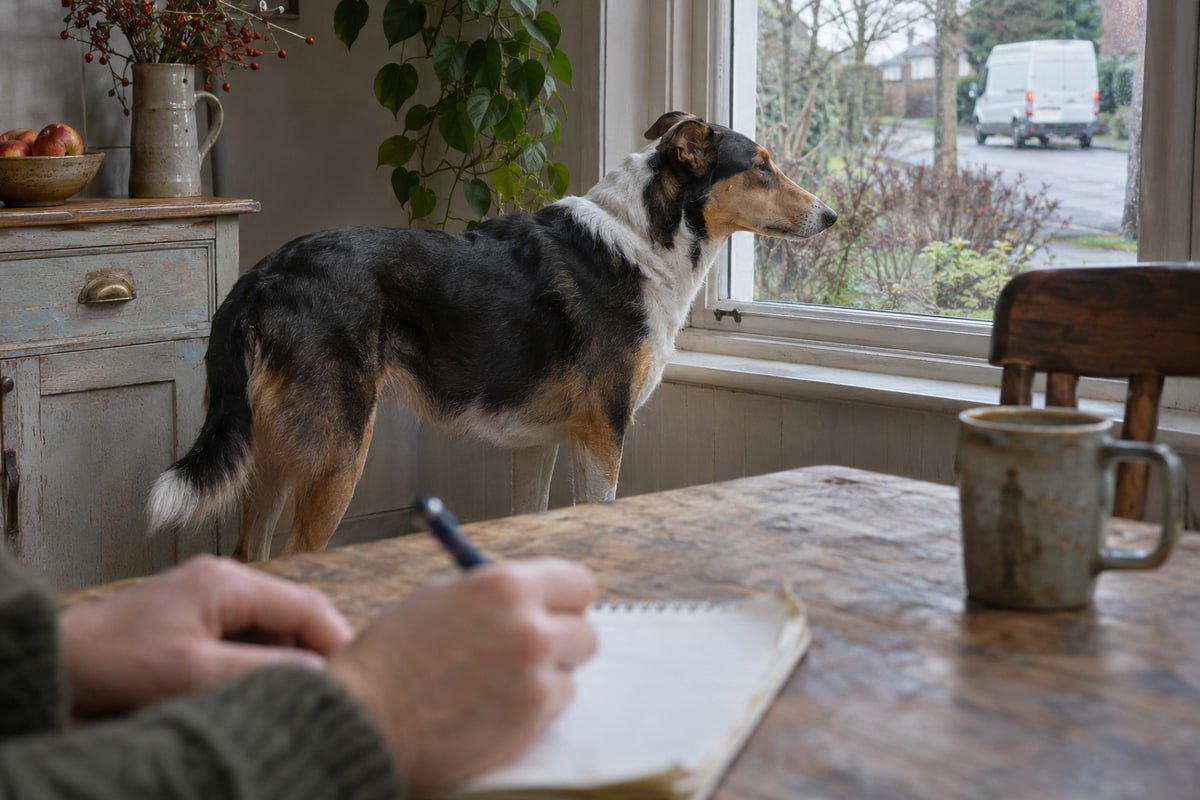
For a fixed view of the street, compare a German Shepherd watching passersby with a Dachshund barking through low glass. If the same delivery sets it off each day, see the Doberman mail-carrier example.
Window film helps. The ASPCA lists removable film for dogs who guard the view. PetMD says privacy film can reduce alert barking without any training. Soft music or white noise covers sounds from outside.
Best Friends describes a door game. You say “Who’s there?”, someone knocks, and your dog barks. Then you give a stop cue like “enough”, show a treat or toy, and reward the quiet.
Some trainers teach a set number of barks. PetMD describes teaching a dog to bark a few times, then go to a mat or bed for a treat.
How do you stop demand barking?
Do not give your dog what they ask for while they bark. Wait for a pause, reward it, then slowly lengthen the wait.
PetMD describes demand barking as short, with pauses, while the dog looks at you or the thing they want. Every reply can count as a reward. The ASPCA adds that even eye contact or a scolding can feel like one.
Best Friends advises ignoring the barking. Then gradually increase how long your dog must be quiet before you grant the request. In a crate, check for a potty need or distress before waiting for a pause.
Boredom can look the same. Best Friends suggests durable rubber and nylon toys, a variety of food puzzles and family time. PetMD also lists more exercise and puzzle toys.
How do you stop fear barking?
Never punish fear barking. Reward calm moments, and ask a certified trainer for help if it is intense.
Barking at strangers or odd objects can come from worry. Best Friends suggests a training class and rewarding your dog only when they are relaxed. PetMD says barking that looks aggressive is often fear based.
For visitors, the AKC says dogs with more positive experiences bark less. If your dog is worried about a visitor, give them room behind a barrier and reward calm from a distance. PetMD says leash-reactive dogs should be evaluated by a certified professional.
How do you teach the Quiet cue?
Teach Quiet while things are calm. Say “Quiet,” feed tiny treats, then wait longer before each treat: 2, 5, 10, then 20 seconds.
The ASPCA describes this method. When your dog barks, calmly say “Quiet” and feed a steady stream of pea-sized treats. Do not shout the cue.
- Practice with a safe trigger, such as a doorbell, as the AKC suggests.
- Use treats your dog loves, in tiny pieces.
- If Quiet fails after 10 to 20 tries, the ASPCA says to find a certified behavior professional.
Have a barking puppy at home?
The Puppy Protocol is a four-week barking plan made for puppies, with fillable worksheets.
For puppies, use short sessions and check basic needs more often.
What about barking at night, in the crate or at other dogs?
Start by checking what sets off the barking and what your dog needs in that moment. None of our sources give a separate night plan.
- Night. PetMD suggests soothing music or a white noise machine for dogs who bark at sounds.
- Crate. Check for a potty break or signs of stress. Read what to do when your dog barks in the crate before trying a longer session.
- Other dogs barking. The ASPCA lists socially facilitated barking and suggests playing music. PetMD says a Quiet cue works when you hear other dogs barking.
- Walks. PetMD notes anxious barking appears when a stranger or another dog approaches.
What if a neighbor or landlord is already complaining?
Start the plan today and tell them you are working on it. Fast action matters more than a perfect plan.
Two hallway examples show where to start when footsteps carry through a closed door. Compare a Chihuahua at an apartment threshold and a Yorkie hearing people pass.
This part is our own practical advice, not from the sources above. A short, friendly note costs nothing. It says you know about the noise and are working on it.
Window film, closed blinds and music help the same day. Write down what you try, so you can show a plan. We did not research local noise rules, so check your lease or city rules for what they require.
What if your dog only barks when you leave?
Barking only when you are gone, with panic, can point to separation anxiety. That needs your vet or a certified trainer, not a bark device.
Compare what a recording can tell you about a Husky howling at the sound of keys and a Pit Bull barking after the door closes.
The AKC lists familiar sounds, puzzle toys and exercise before you leave. It also suggests training short absences, adding a few seconds at a time. Watching your dog on a camera can show what triggers the barking.
If your dog panics, stops eating, hurts themselves or destroys things when left alone, talk to your vet or a certified trainer.
When should you call your vet about barking?
Call if barking starts suddenly, looks rigid and repeated, or comes with pain or confusion. The ASPCA says to rule out illness or injury first.
The guides for new barking in a French Bulldog and a usually quiet Bulldog show which observations to write down.
A sudden change deserves a checkup. So does compulsive barking at shadows, light flashes or mirrors, especially with spinning or circling.
Should you reach for an anti bark device?
Not as a first step. The ASPCA calls anti-bark collars punishment devices and not a first choice, and PetMD says never to use one.
Fix the reason first. If you still wonder whether a handheld device could suit your dog, read our ultrasonic dog bark deterrent review.
Wondering if a bark device could suit your dog?
Check the boxes that match your dog and write down one thing to try. You get a free one-page printable PDF. Enter your email to get it.
Quick answers
What is the fastest way to stop a dog from barking?
No source we read promises an instant cure. The quickest safe start is a calm voice, a blocked view and a treat for the first quiet moment.
Which home changes help with barking?
Our sources suggest window film or closed blinds, music or white noise, and chew or puzzle toys. Exercise before you leave also helps.
Should I yell at my dog to stop barking?
No. The AKC says barking is contagious, so yelling can add fuel. The ASPCA says scolding can feel like a reward.
Do anti-bark collars work?
The ASPCA calls them punishment devices and not a first choice. PetMD says never to use an anti-barking device.
Sources
- AKC: How to Stop Nuisance Dog Barking and Why Does My Dog Bark at Nothing?. Common mistakes, blinds, crate, mail carrier, Quiet practice.
- ASPCA: Barking. Attention barking, window film, Quiet training, vet check and anti-bark collars.
- Best Friends Animal Society: How to Stop Dog Barking. Door game, demand, fear and boredom fixes.
- PetMD (vet reviewed): How To Stop a Dog From Barking and 5 Reasons Your Dog Won’t Stop Barking. Management, bark count, three seconds of quiet.
About the author
Michael Northcutt, PhD
Founder, PawsPurrfection.com · Certified Pet Therapy Specialist · Certified Companion Animal Rehabilitation Therapist (CCAT) · Member, AAPT Certification Board
Dr. Michael Northcutt is a pet therapy and companion-animal rehabilitation professional with 14 years of experience. His work covers animal-assisted interventions, rehabilitation, animal welfare and the human-animal bond.
He holds the CCAT credential from North Carolina State University College of Veterinary Medicine. He also serves on the Animal Assisted Play Therapy® (AAPT) Certification Board. He was a keynote speaker at the 2017 International Veterinary Symposium Conference.
His core principle: what we do for an animal should support its health, comfort, safety and quality of life. Not a veterinarian.
Disclaimer: This page is general education, not veterinary advice. Call your vet about any sudden or worrying change in your dog.