Labrador barking / Updated
Why your friendly Lab barks at everything, and how to turn the greeting roar into a calm hello
A plan for the happiest barker in the house, from doorbell chaos to a calm hello.
 By Michael Northcutt, PhD · Last updated November 26, 2026January 2027 series ·
We read VCA, the AKC, the ASPCA and PetMD for this guide. General education only, not veterinary advice.
Quick answer: Labs bark from excitement, boredom and attention seeking. Give daily exercise, teach a calm greeting, reward quiet, and never reward the roar with a fuss.
Key takeaways
- Most Lab barking is joy, boredom or attention. It is rarely mean.
- Exercise and structure come first. VCA says Labs need both.
- Reward calm before the door opens, the leash clips or the bowl goes down.
Your Lab is the friendliest dog you have ever met. The doorbell turns that sweetness into a roar.
Guests flinch. The neighbors hear it. You feel half proud and half embarrassed.
VCA lists the breed’s energy level as high. That energy needs a plan, and this page gives you one.
What can you do in the next minute?
Keep your voice low, give your Lab a job, and reward the first pause. A sit on a mat beats a shout every time.
Do this now
- Speak low. The AKC says that yelling sounds like you are barking too.
- Ask for a sit or a go to mat.
- Wait for quiet. Give a treat.
- Skip the fuss until the barking stops.
Is my Lab barking from joy, boredom or alert?
VCA rates Lab barking as moderate. Most Lab noise has a simple cause: excitement, boredom or a wish for attention.
VCA lists the breed’s barking level as moderate and its energy as high. The AKC says that a bored dog needs something to do, and an anxious dog needs to build confidence.
Watch what comes right before the barking. That tells you what your Lab wants.
| What you notice | Your first move |
|---|---|
| Barks and jumps when guests arrive | Excitement. Mat, sit, then greet. |
| Barks while you cook or eat | Attention or food. Teach a down away from the kitchen. |
| Barks after a short walk | Extra energy. Add a longer walk or a fetch game. |
| Barks at passers by | Alert barking. Block the view and reward quiet. |
| Barks and chews when alone | Boredom or anxiety. Exercise first, then ask a pro if it stays. |
Why does my Lab bark at the door and at guests?
A guest is the best event of your Lab’s day. The AKC says not to let an overstimulated dog greet guests at the door.
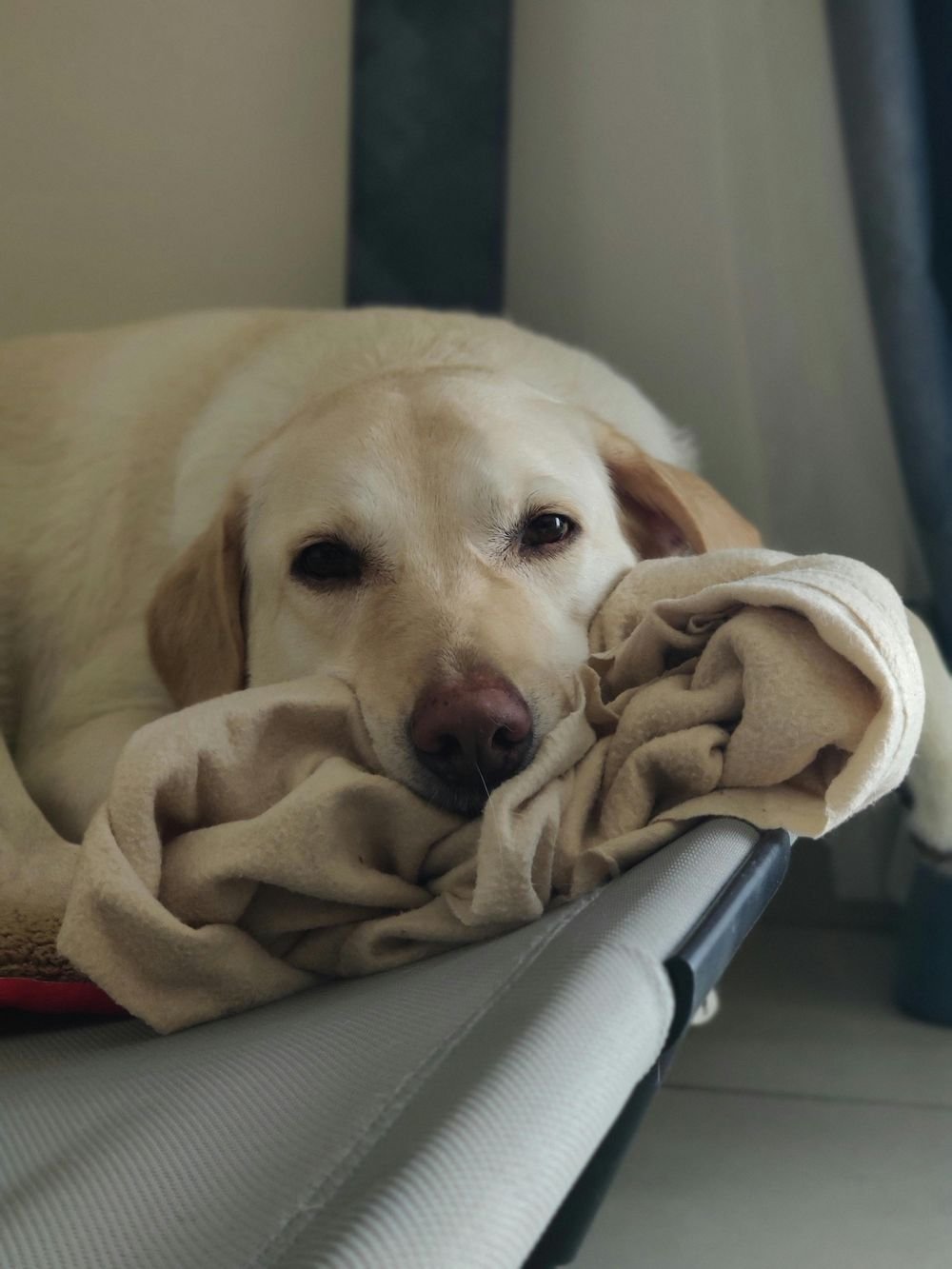
The door and window barking plan can help you rehearse before visitors arrive.
The AKC advises you to not let an overstimulated dog greet guests at the door. Put your Lab on a leash or behind a gate first. Ask for a sit. Let the guest in only when your dog is calm.
Practice with a friend before the real visit. A short drill beats a long lecture.
Why does my Lab bark for attention or food?
Barking works when it gets a fast reply. The AKC says barking usually gets an immediate response. Reward quiet, not noise.
The AKC says barking usually gets an immediate response. So your Lab learned the trick. Turn it around. Turn your back or walk away while the barking goes on. Give attention when your dog is quiet.
The ASPCA says to say Quiet, then feed a steady stream of pea-sized treats.
Is my Lab getting enough exercise?
VCA says Labs need significant daily exercise. Without it, they may gain weight or develop destructive behaviors. Tired Labs bark less.
VCA lists significant daily exercise for the breed. It warns that without enough activity they may gain weight or develop destructive behaviors. A walk, a swim or a game of fetch can burn the energy that fuels the noise.
Add a brain game too. A treat puzzle or a scent search tires a Lab fast. That tip is our own advice.
Why does my Lab bark when I leave?
VCA says Labs have moderate tolerance for time alone once trained and exercised. Exercise before you leave, and build up absences slowly.
VCA lists moderate tolerance once trained and exercised. So give a good walk before you go. Leave a chew. If the barking comes with panic or damage, ask your vet or a certified trainer.
What if the neighbors complain about my Lab?
Share your plan, ask which times bother them, and give the longest walk just before those times.
Tell your neighbor you are working on it. Most people relax when they see effort.
A tired Lab barks less. Add a long sniff walk or a fetch game before the quiet hours.
If the barking happens at night, keep the evening calm and the doorway view blocked.
This is our own advice, not a source finding.
What is the step by step plan?
Exercise, calm greetings, Quiet cue and rewards. Keep sessions short. Everyone in the home uses the same rules.
- Exercise first. Do the big walk before the visitors, not after.
- Teach a mat. Reward your Lab for lying on it when the bell rings.
- Teach Quiet. Say it calmly, then reward the pause.
- Reward calm. Treat the sit, the down and the quiet. Skip the treat for the roar.
Wondering if a bark device could suit your Labrador?
Check the boxes that match your dog and write down one thing to try. You get a free one-page printable PDF. Enter your email to get it.
What if your Lab is a puppy?
VCA says Labs are quick learners who respond well to positive training. Start young, keep it fun, and reward calm often.
VCA says Labs are usually quick learners and respond well to positive training. It adds that their energy is high and requires structure. Short, happy lessons build that structure.
Got a Lab puppy and a noisy household?
The Puppy Protocol is a digital download with situation cards, short reward-based lessons, worksheets and a four-week household roadmap. It does not promise your puppy will stop barking.
How long until it gets better?
No source gives a date. Most owners see small gains in weeks, not days. Track loud episodes to see your trend.
This is our own advice. If nothing changes after a few weeks, ask a certified trainer. The AKC says persistent barking may need help from a qualified trainer.
Should you use an anti bark device?
Not first. PetMD advises against anti bark devices. Give exercise and training a fair try, then read our review if you still wonder.
Most Lab barking is joy or boredom, not defiance. Punishing it rarely helps. Our review explains what a handheld unit is and who should skip it.
Wondering about a handheld device?
Our review explains how an ultrasonic unit works, who should skip it, and what to try first.
Quick answers
Do Labradors bark a lot?
VCA rates Lab barking as moderate. Most barking comes from excitement, boredom or attention seeking.
How do I stop my Lab barking at the door?
Do not let an overstimulated dog greet guests. Ask for a sit on a mat, then reward quiet before the door opens.
Why does my Lab bark for attention?
Barking often gets an immediate response. Reward quiet moments, and teach a sit or down to ask for what your dog wants.
Does exercise stop Lab barking?
VCA says Labs need significant daily exercise and may develop destructive behaviors without it. More exercise often helps, but training matters too.
Sources
- VCA: Labrador Retriever. Barking level, energy, exercise and training.
- AKC: Excessive Dog Barking: Causes and How to Stop It. Boredom, anxiety and trainer help.
- AKC: Understanding and Managing Excessive Barking in Dogs. Attention barking, guests and yelling.
- ASPCA: Barking. Quiet cue training.
- PetMD: How To Stop a Dog From Barking. Devices.
About the author
Michael Northcutt, PhD
Founder, PawsPurrfection.com · Certified Pet Therapy Specialist · Certified Companion Animal Rehabilitation Therapist (CCAT) · Member, AAPT Certification Board
Dr. Michael Northcutt is a pet therapy and companion-animal rehabilitation professional with 14 years of experience. His work covers animal-assisted interventions, rehabilitation, animal welfare and the human-animal bond.
He holds the CCAT credential from North Carolina State University College of Veterinary Medicine. He also serves on the Animal Assisted Play Therapy® (AAPT) Certification Board. He was a keynote speaker at the 2017 International Veterinary Symposium Conference.
His core principle: what we do for an animal should support its health, comfort, safety and quality of life. Not a veterinarian.
Disclaimer: This page is general education, not veterinary advice. Call your vet about any sudden or worrying change in your dog.