Puppy care articles / Bark deterrent review
Do ultrasonic bark deterrents stop barking? What to try before the next delivery and when to skip the handheld
Some dogs pause when you press the button. The next knock can set them barking again.
Before the next delivery, practice sending your dog to a mat a few steps back from the door. If noise frightens your dog or the barking starts after you leave, skip this handheld.

Paws Purrfection sells this handheld. Our editors checked the supplier footage and published research. Michael shares his own family’s experience below.
The driver is on the step. Your dog has both front paws on the door. You’ve got a hand on the collar and you’re calling, “Just a second!” What would help most right now is being able to turn the handle without your dog slipping through.
For today’s delivery, ask the driver to leave the parcel outside or put a gate across the hall before opening up. You can practice the doorbell later, when nobody is waiting on the other side.
Will an ultrasonic deterrent stop the next round of barking?
A handheld can get a dog’s attention. Whether the dog settles when the visitor stays is a different question. If a demonstration ends the moment the barking stops, you never get to see what happens at the next knock.
The anti-bark device evidence guide explains why the next delivery matters when judging results.
In a study by Blackshaw and colleagues, researchers tried three ultrasonic devices with 15 dogs. None made every dog move away at any setting tested. The researchers measured how dogs reacted to sound. They didn’t test this handheld or measure barking during a delivery.
Who has to press the button?
You do. An automatic bark box can respond to barking on its own. This handheld needs a person there, so leaving it on the kitchen counter while you’re at work won’t help.
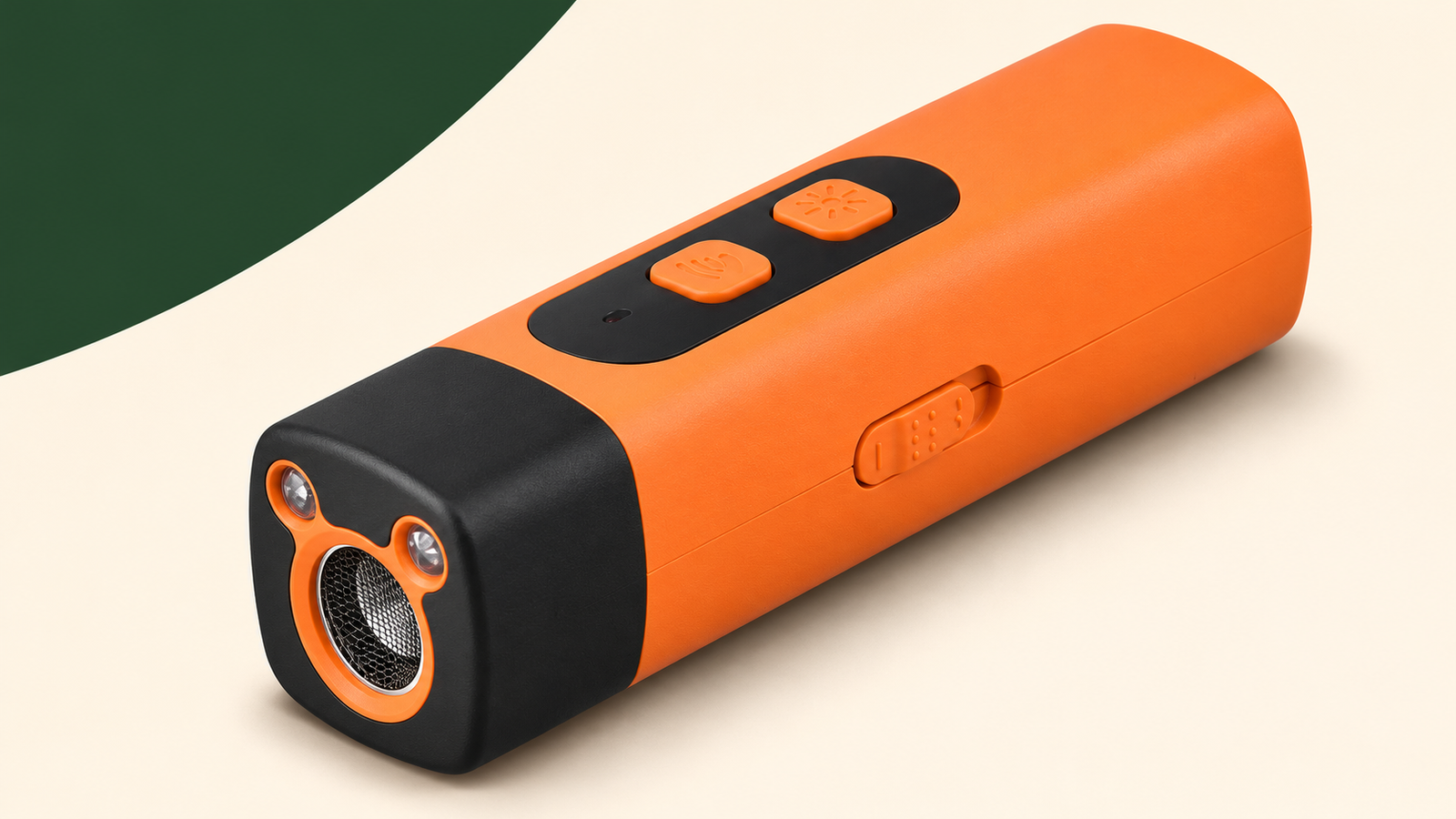
Inside the supplier demonstration
Watch the handler’s thumb.The supplier shows the controls up close. You can judge how you’d hold the device. The footage gives us no measurement of what a dog hears.
18 seconds · Supplier footage · Open video
What can I do before the next delivery?
Start with the door shut and a mat a few steps back. Give your dog somewhere worth going before you add the sound that sends them running.
At Michael’s front door
My friend brought her little boy over. My puppy jumped up to say hello and he tumbled backward into the bushes. He was okay, but he cried. I’d been shouting “Off!” and “Sit!” while trying to open the door. Looking back, I was adding to the excitement.
I taped a note inside the door: “Mat. Treat. Wait. Then say hi.” That note was for me.
- First, make the mat familiar. Drop a treat on it and let your dog walk over. Once they head there readily, say “mat” just before they move. Give the next treat where you want them to wait.
- Turn down the knock. Michael played a quiet doorbell sound on his phone. A soft tap works for practice, too. Can your dog hear it and still turn back to you? That’s a chance to cue the mat. If they rush the door, try a softer tap or move farther away.
- Give the next guest a plan. Ask them to text from outside. Put the gate in place, let the guest come in and sit down, then see whether your dog is ready to greet them.
When the same boy came back, Michael’s puppy waited behind the gate, wagging, until he was sitting on the couch. Then she greeted him with four paws on the floor. This time he giggled. She still barked sometimes. Getting a child through the doorway comfortably was the change the family wanted.
If your dog rushes to the window as well as the door, the puppy barking training guide can help you identify what sets them off.
What if my neighbor hears barking while I’m out?
A handheld on the counter can’t respond while you’re away. If you’ve had an uncomfortable text from a neighbor, ask one practical question: “About what time did you first hear it?” That gives you somewhere to start.
Record an ordinary departure with sound if you can. A dog who barks at footsteps and goes back to sleep gives you a different picture from one who keeps pacing and scratching at the door. Save the part before the first bark, too. If you see repeated distress, share the clip with your veterinarian.
Could the sound scare my dog or bother my other dog?
We have no independent hearing-safety measurements for this model. A sound you barely hear can still startle your dog. If they flinch, freeze, hide or try to leave, put the device away and give them room.
Think about the dog curled up under the kitchen table. They may hear the same sound as the dog barking at the window. If a smoke alarm chirp already sends either dog into hiding, leave the handheld off your shopping list.
Owners reported noise sensitivity in 32% of dogs in a large Finnish survey. That finding was about everyday sounds. It doesn’t tell us how loud this handheld is or how your individual dog will respond.
What do veterinarians recommend?
Veterinarian Teresa Manucy advises against anti-barking devices in PetMD’s barking guide. VCA Animal Hospitals describes how a handheld can interrupt barking and why the interruption can wear off. For the dog at your door, both guides point to a useful next step: reward a response you want to see again.
“Reward-based techniques should be used for teaching common training skills as well as to address unwanted behaviors.”
American Veterinary Society of Animal Behavior, Humane Dog Training Position Statement
Why did the device work once and then stop?
The first time, your dog may have turned to find the new sound. Once the sound is familiar, the person on the step may be more interesting. VCA notes that dogs can learn to ignore a device. A louder setting won’t tell your dog where to go.
Put it away for your next rehearsal. Try a quiet knock and see whether your dog follows a familiar cue to the mat. Keep track of something you can actually see: can they stay there while you open the door a crack?
Is this handheld a good fit for my household?
If your dog already looks up when you call, you have the moment you need to cue the mat. Try that before buying a handheld. The store lists this model for dogs 6 months to 8 years old. Age alone can’t tell you whether the sound suits your dog. For a young puppy, start with the puppy device-suitability guide.
Still unsure about your dog?
Answer three questions and see your next step on screen. No email needed.
Click Here to Check Your Dog’s FitWant something to share at home? Click Here for the Printable Fit Check (Email Required).
| Your question | Store details |
|---|---|
| What comes in the box? | The handheld, a USB-C charging cable and printed instructions. |
| When will it arrive? | US shipping is free. The usual delivery estimate is 1 to 2 weeks. |
| What if it’s a poor fit? | You can request a full refund within 45 days of delivery. No return shipment is required. Read the refund terms. |
If you’re considering this model, the store has an indoor and an outdoor demonstration. Click Here to Watch the Handheld in Use.
What about dog whistles, shared walls and stronger devices?
What does “ultrasonic” mean?
It describes a pitch above the usual range of human hearing. The term tells you nothing about how loud a particular device is at your dog’s ear.
Does the sound cancel out barking for my neighbors?
No. The unit adds a sound your dog may notice. It doesn’t cancel the bark that travels through the wall.
Is this the same as a dog whistle?
You press a button on this handheld. A whistle can be a cue you deliberately teach, just as calling your dog’s name can be. An unfamiliar sound on its own gives your dog no instructions.
Will it work through a shared wall or fence?
We couldn’t verify a through-wall range for this handheld. The published ultrasound experiment tested devices from one meter away. It can’t tell you what reaches a dog on the other side of a fence.
Would a stronger device work better?
A stronger reaction doesn’t tell you that a dog will settle. In Blackshaw’s second experiment, 13 of 14 dogs reacted immediately to one unit. The researchers classified nine reactions as aversive. Two dogs showed apprehension and two pricked their ears. The experiment measured reactions to that unit, not whether dogs barked less at home.
Sources and what they tell us
- Blackshaw and colleagues, Applied Animal Behaviour Science · Measured dogs’ reactions to several sound devices.
- Salonen and colleagues, Scientific Reports · Reported how commonly owners observed noise sensitivity.
- VCA Animal Hospitals, Barking in Dogs · Explains interruption, training and why dogs may ignore a device.
- Teresa Manucy, DVM, for PetMD · Gives practical alternatives to anti-barking devices.
- American Veterinary Society of Animal Behavior · Sets out its position on humane, reward-based training.