Dog barking in crate / Updated
Dog barking in the crate? What to check before you wait
If your dog barks in the crate, check whether they need a toilet break or are getting distressed.
End the session if they’re distressed, then practice again with the door open or closed for just a few seconds.
 By Michael Northcutt, PhD · Last updated November 27, 2026January 2027 series ·
We read PetMD, Humane World, VCA, AKC and ASPCA pages for this guide. General education only, not veterinary advice.
Quick answer: Take your puppy out calmly if a toilet break is due. If barking escalates or your dog pants, drools or tries to escape, end the session and make the next one easier. If your dog is relaxed and the noise is fading, give them a moment to settle.
Key takeaways
- Check for a toilet need and signs of distress first.
- Start with the door open and build up to a few seconds with it closed.
- Ask your vet for help if barking starts suddenly, persists or comes with signs of panic.
What can you do right now?
Think about when your dog last went outside. If a toilet break is due or you’re unsure, take them out on leash and give them a chance to go. Keep the trip quiet and brief.
If your dog is panting, drooling, or trying to get out, calmly end the session. If you see an injury or suspect pain, contact your vet.
Why do dogs bark in the crate?
PetMD says puppies cry in the crate because of loneliness, fear, a potty need or attention seeking.
For barking outside the crate too, use the puppy guide to toilet needs, comfort and everyday triggers.
PetMD calls it normal for a puppy to cry in a crate, especially after leaving the litter. Its list of reasons is loneliness, fear, needing a potty break, or seeking attention. The AKC adds one more: dogs also bark in a crate simply to be let out.
Why is my dog suddenly barking in the crate?
A sudden change often means the plan moved too fast. Humane World says to go back to a shorter time.
Did you lengthen the sessions this week? If your dog began to whine, Humane World says you may have increased the length of time too quickly. Step back to the last time that went well.
If nothing changed in the plan, check the potty gap and your dog’s health. A sudden change can have a medical cause, so call your vet if it persists.
Should I ignore my dog barking in the crate?
If you hear a brief whine that’s already fading and your dog looks relaxed, stay nearby and give them a moment to settle. If the noise builds or your dog can’t settle, open the crate calmly and shorten the next session.
Humane World’s crate training guide recommends building crate time gradually and taking a young puppy out if a toilet trip is likely.
What does the sound mean?
Match the sound to the likely cause. These are common patterns, not a diagnosis.
| What you notice | Your first move |
|---|---|
| Short whining that fades in a few minutes | Stay nearby briefly if your dog is relaxed and the sound is fading. |
| Crying that keeps going, with a recent potty gap | Take your puppy out calmly. Resume practice later if they’re unsettled. |
| Barking to be let out, then stops when you come | Check basic needs and body language. A pause alone cannot tell you why the dog was barking. |
| Barking or panic only when you leave | Possible separation anxiety. See your vet or a trainer. |
| Barking after you made the sessions longer | You may have gone too fast. Go back to shorter times. |
What is the step by step plan?
Build crate time in small steps and open the door while your dog is still comfortable.
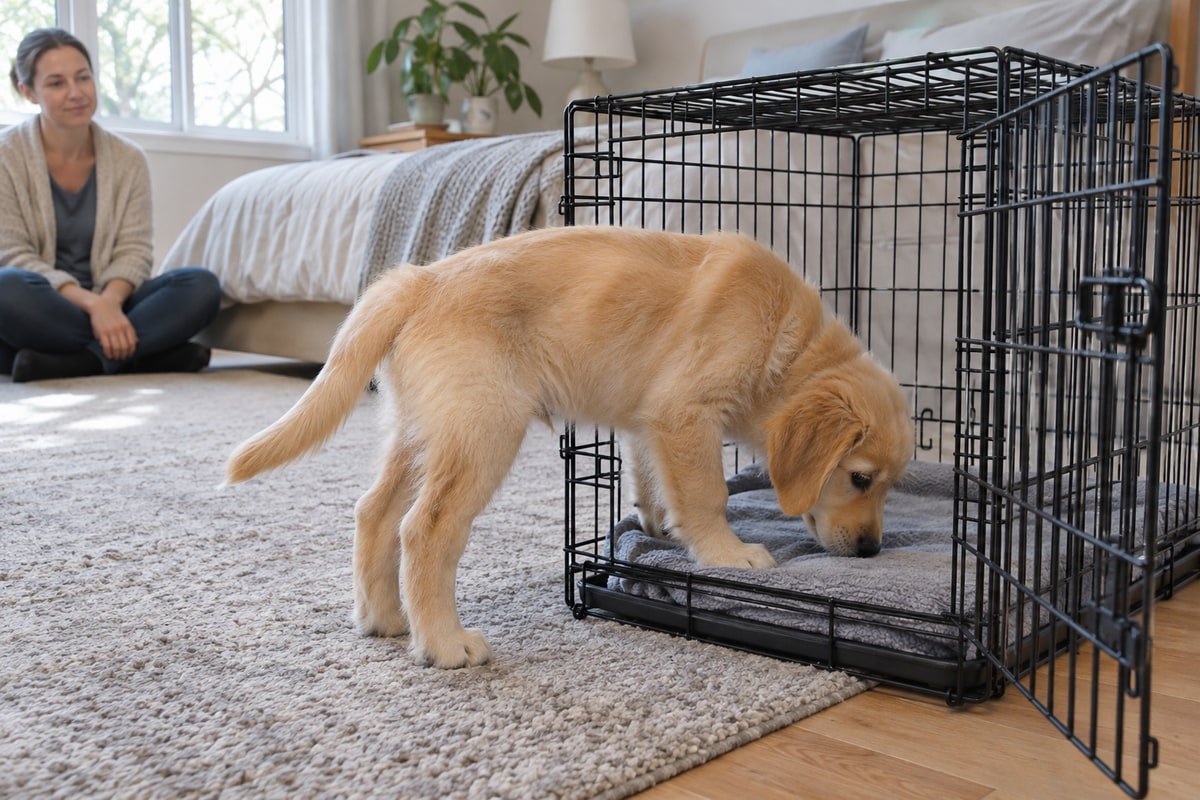
- Make it good. Humane World says to feed meals in the crate first. Move on once your dog shows no sign of fear or anxiety.
- Start short. Keep early sessions brief while you are home.
- Practice the door. Close it for a second or two while you sit nearby. Open it while your dog is still comfortable. If they get worried, practice again with the door open.
- Lengthen slowly. Add time only after the last step went well.
Crate training a puppy?
The Puppy Protocol is a four-week barking plan made for puppies, with fillable worksheets.
Does music, a radio or a calming scent help?
It may. VCA says a radio or TV in the background can calm a dog alone in the crate.
VCA says a radio or television in the background may help. It can also mask noises that set off barking. VCA notes some evidence for a pheromone spray or diffuser. PetMD suggests soothing music next to the crate.
VCA also says the crate should not be used as punishment. Keep it a happy place.
What if it is more than the crate?
If distress starts when you leave or when the door shuts, ask your vet for help identifying the trigger.
The AKC says that if separation anxiety is the trigger, this may require a completely different approach. The ASPCA notes that confinement can add stress for some dogs with separation anxiety. Tell your vet whether you see the same signs when your dog is alone outside the crate.
Should you use an anti bark device?
Not as a first step. PetMD says never to punish a dog for barking or use an anti-barking device.
Fix the cause and the schedule first. If you still wonder whether a handheld device could suit your dog, read our ultrasonic dog bark deterrent review.
Wondering if a bark device could suit your dog?
Check the boxes that match your dog and write down one thing to try. You get a free one-page printable PDF. Enter your email to get it.
Quick answers
Is it normal for a puppy to cry in the crate?
PetMD says it is normal, especially after separation from the litter. Causes include loneliness, fear, a potty need or seeking attention.
Should I let my dog out when they bark in the crate?
Yes if they may need the toilet or are distressed. If they’re comfortable and a brief whine is fading, give them a moment to settle.
How long should I let my puppy cry in the crate?
Watch their body language and check when they last went to the toilet. Respond if they are getting more upset or might need to go.
Can a crate be used as punishment?
VCA says the crate should not be used for punishment.
Sources
- PetMD: Puppy Crying in His Crate? Here’s What To Do. Reasons and timing.
- Humane World for Animals: pet tips ebook. Ignore, reward quiet, go slower.
- VCA: How to Crate Train Your Dog. Radio, scent and no punishment.
- AKC: How to Stop Nuisance Dog Barking. Waiting for quiet and separation anxiety.
- ASPCA: Barking. Consistently not rewarding barking.
About the author
Michael Northcutt, PhD
Founder, PawsPurrfection.com · Certified Pet Therapy Specialist · Certified Companion Animal Rehabilitation Therapist (CCAT) · Member, AAPT Certification Board
Dr. Michael Northcutt is a pet therapy and companion-animal rehabilitation professional with 14 years of experience. His work covers animal-assisted interventions, rehabilitation, animal welfare and the human-animal bond.
He holds the CCAT credential from North Carolina State University College of Veterinary Medicine. He also serves on the Animal Assisted Play Therapy® (AAPT) Certification Board. He was a keynote speaker at the 2017 International Veterinary Symposium Conference.
His core principle: what we do for an animal should support its health, comfort, safety and quality of life. Not a veterinarian.
Disclaimer: This page is general education, not veterinary advice. Call your vet about any sudden or worrying change in your dog.