Pit Bull barking / Updated
Pit Bull barking when you leave: why it happens and how to help
Barking as you leave can be a brief reaction to the door or a sign that your dog is distressed. Record the first few minutes of a normal departure and see whether your Pit Bull settles or keeps pacing and calling.
 By Michael Northcutt, PhD · Last updated November 27, 2026January 2027 series ·
We read Dogster, the AKC, the ASPCA and PetMD for this guide. General education only, not veterinary advice.
If the recording shows your dog settling back down, note what set off the bark. If they pace, drool or scratch at the exit and cannot settle, share the recording with your veterinarian.
Key takeaways
- Dogster calls the breed a moderate barker with six common causes.
- Daily exercise is essential. Bored dogs bark more.
- Block the view, reward quiet, and skip punishment.
A neighbor mentions your dog. Politely, but you heard it.
Your Pit Bull is sweet, strong and loud when it counts. You do not want to quiet a good dog the wrong way.
Dogster calls the breed a moderate barker that shouldn’t bark too often or for too long. So heavy barking usually has a cause you can find, and the sooner you act, the easier the fix.
What can you do in the next minute?
Stay calm and low. Move your dog away from the trigger, wait for a pause, and reward it.
Do this now
- Speak low. The AKC says yelling may reinforce barking.
- Block the view or move to another room.
- Wait for one second of quiet. Reward it.
- Skip scolding. PetMD says to never punish a dog for barking.
Why is my Pit Bull barking so much?
Dogster lists six causes: protectiveness, boredom, fear, anxiety, excitement and attention seeking. Find yours first.
Dogster says Pit Bulls may bark more when they feel threatened or want to protect their family.
Match what you see to the table, then try the first move for a week.
| What you notice | Your first move |
|---|---|
| Barks at the door or window | Alert barking. Block the view and teach a mat. |
| Barks and whines when you leave | Possible separation anxiety. Short practice, and ask a pro if it is intense. |
| Barks with a wiggly body | Excitement. Calm greetings and a job to do. |
| Barks and stares at you | Attention. Wait for quiet, then reward. |
| Barks at other dogs outside | Protective or fearful. Add distance and reward calm. |
These rows are practical suggestions, not findings from the sources.
Why did my Pit Bull start barking more all of a sudden?
A new trigger, less exercise or a health change can raise barking. PetMD lists medical causes, so call your vet if it came on fast.
PetMD lists medical causes and separation anxiety among the reasons dogs bark.
Here is what I would check: a new dog next door, a shorter walk routine, or a changed work schedule.
A senior Pit Bull that barks at night for no clear reason should see a vet first.
Why does my Pit Bull bark when I leave?
Watch where your dog goes after the door closes. Note the time of the first bark and whether they return to what they were doing.
Use the guide to barking triggers, including departures to put what you hear on the recording into context.
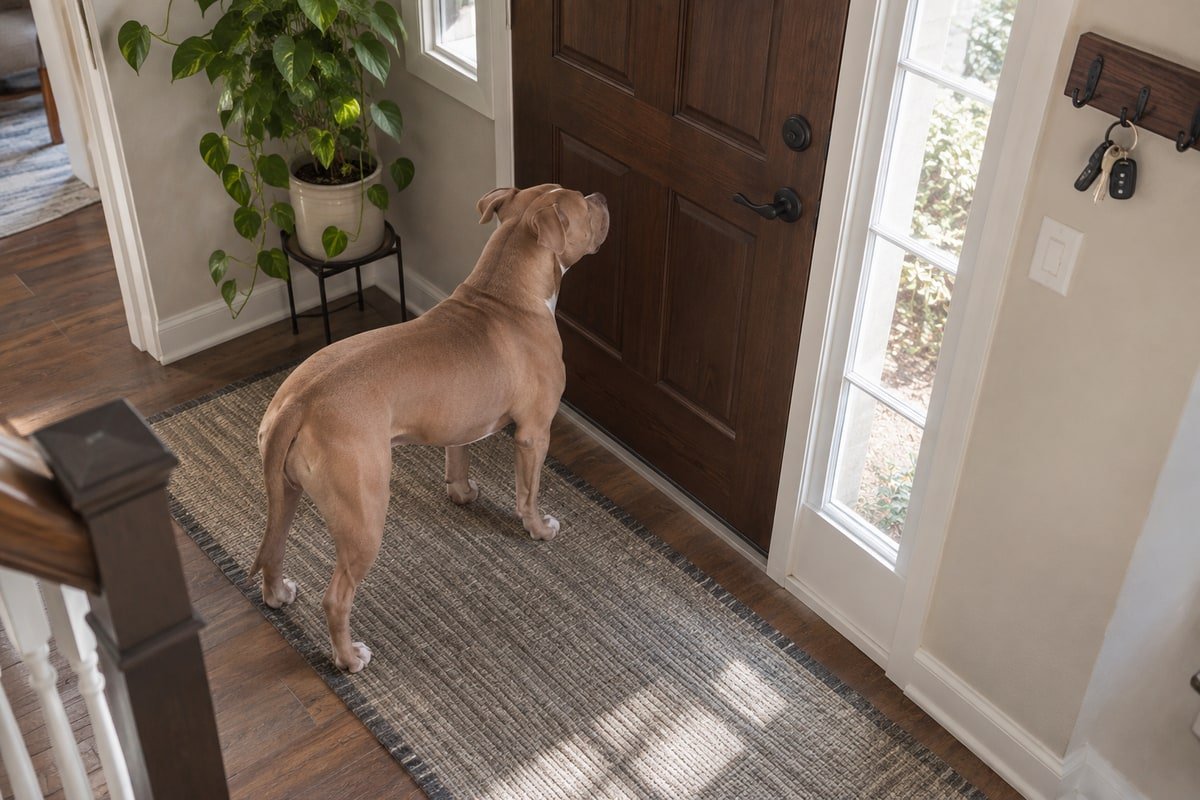
A dog that listens to footsteps and then settles looks different from one that paces, drools or scratches at the door throughout the clip. Barking alone cannot tell you which is happening. ASPCA signs of separation distress
For practice, try an absence short enough that your dog stays relaxed. That might mean stepping out for only a second. Come back before tension builds. If reaching for the handle already causes distress, or your dog tries to break out, share the video with your vet before making departures longer.
How much exercise does a Pit Bull need?
Dogster says plenty of exercise each day, including regular walks, is essential. Bored Pit Bulls bark more.
Dogster says providing plenty of exercise each day, including regular walks, is essential. It also suggests agility or canine sports classes.
The AKC puts it simply: “A bored dog needs something to do.” Try a food puzzle.
How do I stop barking at the window, the doorbell and the fence?
Block the view, set up the trigger on purpose, and reward quiet. The AKC calls blocking the view the most effective fix.
The AKC’s best fix is to block your dog’s view of people and animals going past your home. For guests, it says don’t let your dog greet people at the door.
Try this for deliveries: gate the hall, drop a treat on a mat, and reward calm. Keep sessions short.
A backyard fence is a stage for barking. The AKC says backyard time is not a substitute for mental stimulation and physical exercise.
What if my Pit Bull barks at other dogs on walks?
Add distance, reward calm, and move closer slowly. Ask a qualified trainer if barking comes with lunging.
Dogster lists fear and protectiveness among the causes of barking. A dog that feels crowded may bark first.
A practical step: cross the street early and treat for looking at you. Shrink the distance over weeks.
Ask a trainer for help if it escalates.
What if my Pit Bull barks at night?
If your Pit Bull barks in the crate at night, check for a bathroom need, discomfort or distress. A recording can also reveal whether the sound begins with a noise in the hall.
Note the time, what woke your dog, and how they settled afterward. If the barking is new or comes with pain, pacing or confusion, contact your veterinarian. PetMD on possible causes of barking
What if neighbors or my landlord complain about my Pit Bull?
Ask which times your neighbors hear barking and roughly how long it lasts. Compare their answer with your recording of the departure.
Keep a short log with the time, what was happening, and the change you tried. If you rent, check your lease and respond to any notice you receive.
What is the step by step plan?
Exercise first, block the view, teach Quiet, and build time alone slowly. Keep every session short.
- Exercise first. Walk, sniff or play before you leave.
- Block the view. Use curtains or window film at dog eye level.
- Teach Quiet. Cue it, wait for the pause, then treat. The ASPCA says to feed a steady stream of pea-sized treats.
- Build time alone. Start with seconds and add slowly.
Wondering if a bark device could suit your Pit Bull?
Check the boxes that match your dog and write down one thing to try. You get a free one-page printable PDF. Enter your email to get it.
Does this work for a Pit Bull puppy and a grown Pit Bull?
Yes. Start early with a puppy, and stay steady with an adult. Dogster lists early socialization and positive training as ways to cut barking.
Dogster suggests early socialization, regular exercise and positive reinforcement training that rewards quiet behavior.
Our suggestion: with an adult, change one thing a week, so the dog can keep up.
Barking at home with a Pit Bull, young or grown?
The Puppy Protocol is a digital download with situation cards, short reward-based lessons, worksheets and a four week household roadmap. It is built for puppies, and you can use the same reward-based steps with a grown dog. It does not promise your dog will stop barking.
How will I know whether it is helping?
Compare recordings of similar departures. How soon does your dog settle, and can they relax for a little longer without pacing?
Compare similar situations over time. The aim is a dog who can settle more easily. Occasional barking is normal. ASPCA guidance on realistic expectations
Should you use an anti bark device?
Not first. PetMD advises against anti bark devices. Start with exercise, blocked views and training.
Our review explains what a handheld unit is and who should skip it.
Curious about a handheld device?
Read how ultrasonic units work and who should skip them.
Try the free steps first. Our handheld is meant for dogs 6 months to 8 years, so skip it for a senior or fearful dog.
Quick answers
Do Pit Bulls bark a lot?
Dogster calls them a moderate barker that should not bark often or for long.
Why does my Pit Bull bark when I leave?
A dog may bark at hallway noise or because being alone is distressing. A recording can show whether they settle or keep pacing.
How do I stop my Pit Bull barking at the window?
Close the blind across the pane your dog watches, then reward them for turning away and settling.
Do anti bark devices work on Pit Bulls?
PetMD advises against anti bark devices. Meet your dog's needs and train first.
Sources
- ASPCA: Separation Anxiety. Signs of distress and how to practice short absences.
- Dogster: Do Pitbulls Bark a Lot?. Causes, separation anxiety, exercise and training.
- AKC: Excessive Dog Barking: Causes and How to Stop It. Yelling, blocking the view, guests.
- ASPCA: Barking. Quiet cue and realistic expectations.
- PetMD: How To Stop a Dog From Barking. Medical causes, punishment, devices.
About the author
Michael Northcutt, PhD
Founder, PawsPurrfection.com · Certified Pet Therapy Specialist · Certified Companion Animal Rehabilitation Therapist (CCAT) · Member, AAPT Certification Board
Dr. Michael Northcutt is a pet therapy and companion-animal rehabilitation professional with 14 years of experience. His work covers animal-assisted interventions, rehabilitation, animal welfare and the human-animal bond.
He holds the CCAT credential from North Carolina State University College of Veterinary Medicine. He also serves on the Animal Assisted Play Therapy® (AAPT) Certification Board. He was a keynote speaker at the 2017 International Veterinary Symposium Conference.
His core principle: what we do for an animal should support its health, comfort, safety and quality of life. Not a veterinarian.
Disclaimer: This page is general education, not veterinary advice. Call your vet about any sudden or worrying change in your dog.