Stunick anti bark device review / Updated
Stunick anti bark device review: what do the SB1’s two range figures mean?
The Stunick SB1 can respond automatically to barking, but its advertised 350-foot figure applies to remote use. Stunick lists automatic bark detection at up to 75 feet.
Measure from the proposed mounting spot to the place your dog actually barks. Note which other pets share that space.
 By Michael Northcutt, PhD · Last updated November 27, 2026January 2027 series ·
We checked Stunick’s product page, return policy and public buyer reports. We have not range-tested the SB1. Paws Purrfection sells a manually operated handheld.
Key takeaways
- Automatic detection reaches up to 75 feet. The 350 foot figure is for the remote.
- Stunick lists 60 day returns, covers return shipping and charges no restocking fee.
- Only six Trustpilot reviews exist, too few to judge reliability.
Which distance matters in your yard?
Suppose your dog barks at the gate 90 feet from the patio where you would place the unit. That spot is beyond the manufacturer’s stated automatic detection distance. Yet 90 feet is well inside the large figure printed in the advertising. Decide which mode you were counting on before comparing prices.
Stunick describes a rechargeable unit for indoor or outdoor installation, with automatic detection and a separate remote. It lists USB-C charging and an IP65 enclosure. If you need a mounting accessory or an outlet near the intended position, check the contents of the particular package.
What changes when a unit listens on its own?
A microphone can respond to barking while you are busy. It cannot tell whether a visitor arrived, one dog startled another, or a dog needs to get back inside. On shared property, another animal may be within earshot even if it did not bark. Avoid directing sound at a neighbor’s dog.
The guide to anti-bark device evidence also examines what automatic activation tells you about the dog’s response.
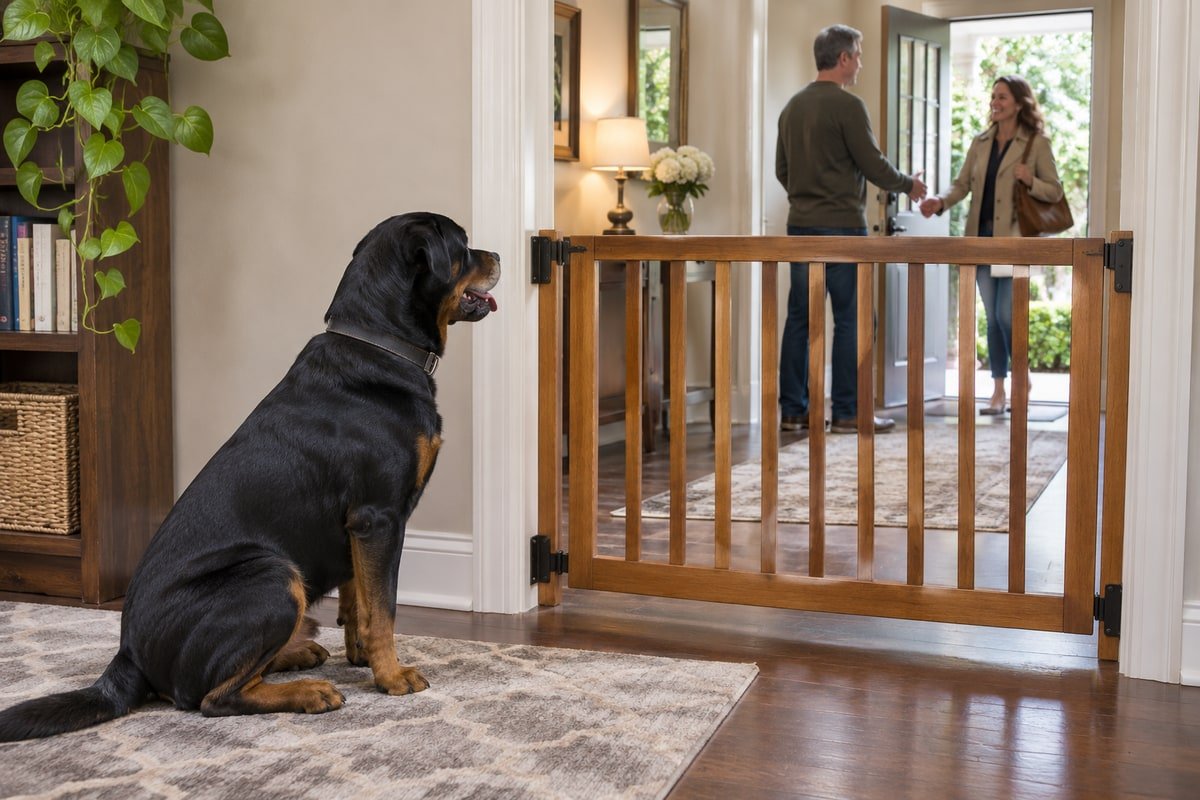
For arrivals, try a physical boundary before choosing a device. Put your dog behind an interior gate where they can see you at a comfortable distance. Practice there with a familiar person before trying it during a delivery. Move the gate or add distance as soon as your dog shows you the setup is too difficult.
What did buyers report about reliability?
Stunick’s Trustpilot profile had just six reviews in the snapshot we checked. One writer described an initial response followed by remote and unit failures. Another reported difficulty obtaining a refund. These are individual accounts, and the small company-level sample cannot establish a failure rate for the SB1.
Already own one and need help? Note which component stopped responding, the purchase date and whether the unit was charged. A written description helps distinguish a remote problem from a question about the dog’s response.
Is the barking happening while you’re home?
Get our free one-page Fit Check card. Tick what matches your dog, then write down one thing to try first.
What should you check before paying?
The product page advertises 60-day returns. Stunick’s written policy says it covers return shipping and charges no restocking fee. Keep your order confirmation and contact the seller for its current return instructions.
A handheld gives the owner control over each activation. The SB1’s automatic mode doesn’t need anyone to press a button. That distinction matters more than the biggest range figure. If your dog hides, shakes or starts barking suddenly without an obvious trigger, give them space and consult your vet. For visitor barking, our doorbell routine provides a way to practice without a sound device.
What is our best choice for your own dog?
For barking while you’re home, our best choice is the Paws Purrfection handheld bark deterrent. You decide each press, then reward the quiet, and its refund needs no return.
| Feature | Stunick SB1 | Paws Purrfection handheld |
|---|---|---|
| Who triggers it | Automatic, or you by remote | You |
| Range | 75 ft automatic, 350 ft by remote | 350 feet |
| Power | USB-C rechargeable | USB-C, 800 mAh battery |
| Age limits | None stated | Dogs 6 months to 8 years |
| Returns | 60 days, free return shipping, no restocking fee | 45 day full refund, no return needed |
Facts from each brand’s own pages on November 27, 2026. Neither device has published independent test results.
Automatic units and bark collars both react without you. A handheld bark control device waits for your press.
The ASPCA says collars that deliver noise are ineffective with most dogs. A wall unit that only makes noise shares that weakness.
We sell it, so we’re biased, and we haven’t range-tested either device. We rank it first because a person stays in the loop.
AVSAB recommends reward-based methods for all dog training. So treat the press as a cue and the treat as the lesson.
If barking happens only while you’re out, neither device fits. The ASPCA notes that separation anxiety barking happens only when a dog is left alone.
Stunick’s 60 day window is longer than our 45 days, which counts in its favor. Ours lists dogs 6 months to 8 years and needs no return for a refund.
See who it suits on the handheld bark deterrent page.
Curious about a handheld device?
Read how ultrasonic units work and who should skip them.
Try the free steps first. Our handheld is meant for dogs 6 months to 8 years, so skip it for a senior or fearful dog.
Quick answers
Does the SB1 automatically detect barking at 350 feet?
Stunick specifies up to 75 feet for automatic detection. The longer 350-foot claim is tied to remote use.
Is a handheld the same as the SB1 remote?
A handheld emits the cue from the device you hold. The SB1 remote controls a separate unit placed in the environment.
How much is the Stunick SB1?
It was listed at $129.95 on November 27, against a $259.95 compare-at price. Check whether a mounting accessory is in your package.
Who pays return shipping for the SB1?
Stunick's written policy says it covers return shipping and charges no restocking fee. Contact support first to get a return authorization.
Sources
- Stunick SB1 specifications
- Stunick return policy
- Stunick buyer reports on Trustpilot
- ASPCA guide to barking
- AVSAB position on humane dog training
About the author
Michael Northcutt, PhD
Founder, PawsPurrfection.com · Certified Pet Therapy Specialist · Certified Companion Animal Rehabilitation Therapist (CCAT) · Member, AAPT Certification Board
Dr. Michael Northcutt is a pet therapy and companion-animal rehabilitation professional with 14 years of experience. His work covers animal-assisted interventions, rehabilitation, animal welfare and the human-animal bond.
He holds the CCAT credential from North Carolina State University College of Veterinary Medicine. He also serves on the Animal Assisted Play Therapy® (AAPT) Certification Board. He was a keynote speaker at the 2017 International Veterinary Symposium Conference.
His core principle: what we do for an animal should support its health, comfort, safety and quality of life. Not a veterinarian.
Disclaimer: This page is general education, not veterinary advice. Call your vet about any sudden or worrying change in your dog.