Doorbell barking / Updated
How to stop a dog barking at the doorbell before the next delivery
Teach your dog to go to a mat when the doorbell rings.
Start with a quiet recording and treats while nobody is at the door.
 By Michael Northcutt, PhD · Last updated November 27, 2026January 2027 series ·
We read the AKC, VCA, PetMD, ASPCA and Cornell pages for this guide. General education only, not veterinary advice.
Quick answer: Ring the bell, give a treat, and repeat when no one is at the door. Then teach your dog to run to a bed when it rings. Until then, use a sign so visitors skip the bell, and do not yell.
Key takeaways
- Retrain the sound first: bell, then a treat, many times, with no one at the door.
- Then teach a bed or mat as the place to go when the bell rings.
- While you train, a sign asking visitors to text can cut the bell triggers.
Ding dong. Your dog erupts, the delivery driver steps back, and your guest laughs a little too hard. You apologize again.
Meanwhile the package sits on the porch while you hold a barking dog by the collar. It is a small scene, and it repeats every week.
A doorbell is a fair place to start training. You control the sound and the setup.
What can you do today, before any training?
Weaken the link between the bell and visitors. VCA suggests a sign asking people not to ring and to text you instead.
Do this today
- Put a sign outside. VCA suggests wording like Please do not ring the doorbell, text us.
- Do not yell. PetMD says the most important thing is not to yell at the dog.
- Divert your dog. PetMD says to take them outside or give them a favorite toy.
- Keep a treat jar by the door, so you can reward quiet fast.
Why does one ding set my dog off?
The bell predicts someone at the door. For many dogs, that means alarm or excitement.
PetMD lists being alarmed as one reason dogs bark. VCA says frustration or fear can cause over-excitement at the door. It adds that it is always easier to prevent a behavior from starting than to fix it later.
The trigger can be sneaky. Cornell’s vet college says alert barking can come from less obvious events, such as a doorbell on television. A show can set your dog off while you sit on the couch.
What is the 3 step plan?
Step one retrains the sound with treats. Step two adds a go to place cue. Step three makes the bell the cue for calm.
If your puppy also barks at meals or during calls, use the puppy barking guide to choose one routine at a time.
- Retrain the sound. The AKC says to start with high-value treats, like smelly or sticky ones. Show the treat, then push the doorbell while your dog licks. Praise and repeat several times.
- Teach a place. Ring the bell, lure your dog to a bed or crate, and treat there.
- Let the bell become the cue. The AKC says the goal is that the doorbell ringing becomes the cue. Your dog goes to bed and waits for a treat.
A helper makes this easier. The AKC says someone can stand outside and push the doorbell. A recorded doorbell on your phone also works. VCA says training must happen when your dog is calm, with no one at the door.
How do you teach Go to Place?
Lure your dog to a bed, treat there, and add a cue word. Fade the lure as your dog gets confident.
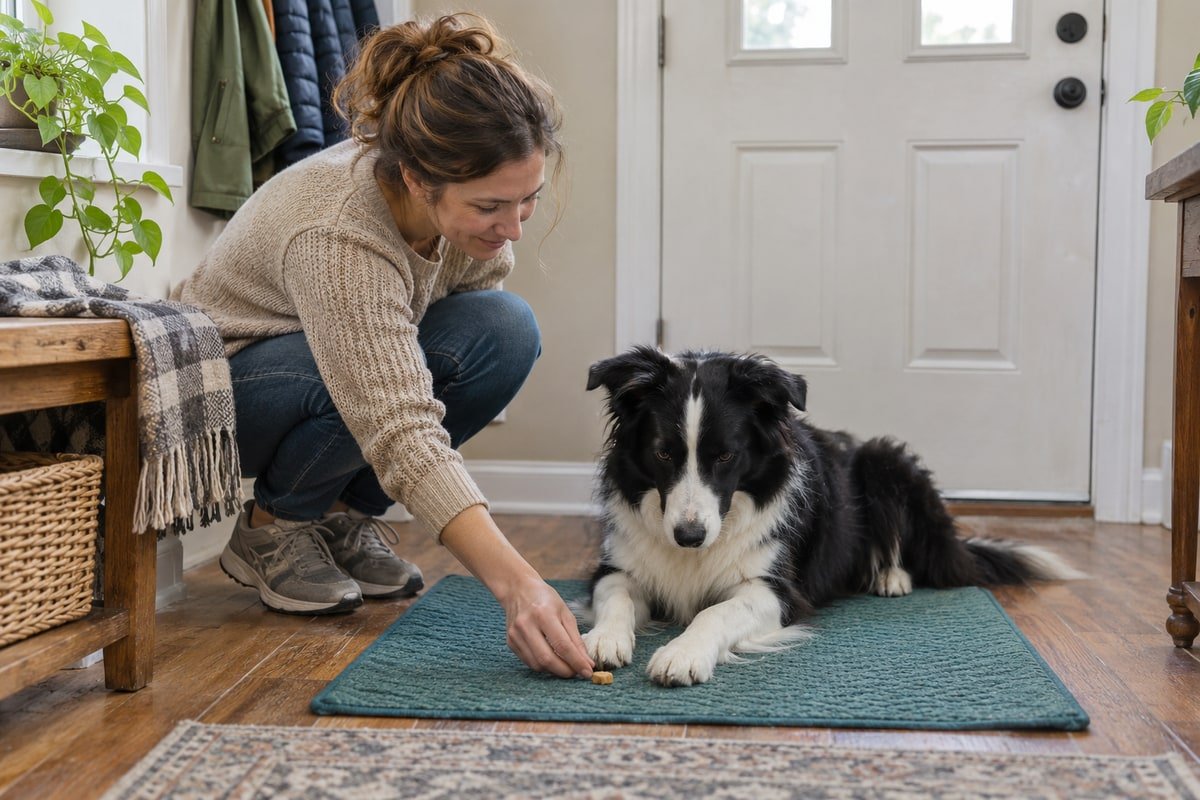
- When the bell sounds, get your dog’s attention with a treat. Praise and lure to the bed.
- Treat when your dog is on the bed.
- Repeat over several sessions across multiple days.
- Add a cue such as go to bed or place, then phase out the lure.
- Open the door and talk to your helper. Keep treating your dog for staying put.
The AKC says to keep a treat jar near the front door. You can then reward fast when someone shows up unexpectedly.
Raising a puppy who already barks at the bell?
The Puppy Protocol is a four-week barking plan made for puppies, with fillable worksheets.
How do you handle guests and deliveries?
Send your dog to a mat first. The ASPCA says your dog should stay quiet there until invited to greet.
The ASPCA says to train your dog to go to an alternate location, like a crate or a mat. Your dog stays quiet until invited to greet. If you want a short alert, the ASPCA allows three to four barks, then a calm Quiet cue.
What if my dog barks at the door to go out or come in?
Give your dog a better way to ask. Cornell suggests teaching a dog to ring a bell to be let in.
Cornell’s vet college suggests you teach your dog to ring a bell to ask to come inside. It gives them an alternative to barking at the door. Reward the ring the way you would reward a quiet pause.
What if I have more than one dog?
Train one dog at a time. A puppy can learn bad habits from an older dog who is wild at the bell.
The AKC warns that a new puppy may learn unwanted patterns from an older dog. Keep the dogs apart during doorbell practice. Work with one, then swap. Bring them together slowly once both do well alone.
When should you get help?
Get help if your dog lunges, snaps or bolts out the door. Safety comes first.
PetMD says you may need a certified professional trainer to help. This is also our advice if your dog darts out the door.
Should you use an anti bark device?
Not as a first step. PetMD says never to punish a dog for barking or use an anti-barking device.
Train the bell first. If you still wonder whether a handheld device could suit your dog, read our ultrasonic dog bark deterrent review.
Wondering if a bark device could suit your dog?
Check the boxes that match your dog and write down one thing to try. You get a free one-page printable PDF. Enter your email to get it.
Quick answers
Why does my dog bark at the doorbell?
The sound predicts a visitor, which is exciting or alarming. PetMD lists alarm as one reason dogs bark.
What is the fastest way to calm doorbell barking?
Skip the bell for now. VCA suggests a sign asking visitors not to ring the bell, while you train.
Download the free door sign and three-line visitor script before the next delivery. Use the tracker to tell a recorded bell, a real knock and a visitor entering apart.
Should I yell when my dog barks at the door?
No. PetMD says the most important thing is not to yell, because it riles the dog up. Divert them with a toy or a trip outside.
How long does doorbell training take?
The AKC says to repeat the steps over several sessions across multiple days. Consistency is key.
Sources
- AKC: How to Stop Your Dog From Barking at the Doorbell. Treat steps, Go to Place, multiple dogs.
- VCA: Barking and Jumping at the Door. Sign, calm practice and prevention.
- PetMD: 5 Reasons Why Your Dog Won’t Stop Barking. Alarm barking and not yelling.
- ASPCA: Barking. Mat training and the Quiet cue.
- Cornell Riney Canine Health Center: Excessive Barking. Hidden triggers and a bell to ask in.
About the author
Michael Northcutt, PhD
Founder, PawsPurrfection.com · Certified Pet Therapy Specialist · Certified Companion Animal Rehabilitation Therapist (CCAT) · Member, AAPT Certification Board
Dr. Michael Northcutt is a pet therapy and companion-animal rehabilitation professional with 14 years of experience. His work covers animal-assisted interventions, rehabilitation, animal welfare and the human-animal bond.
He holds the CCAT credential from North Carolina State University College of Veterinary Medicine. He also serves on the Animal Assisted Play Therapy® (AAPT) Certification Board. He was a keynote speaker at the 2017 International Veterinary Symposium Conference.
His core principle: what we do for an animal should support its health, comfort, safety and quality of life. Not a veterinarian.
Disclaimer: This page is general education, not veterinary advice. Call your vet or a certified trainer about aggression or any sudden change in your dog.