Dog whistles / Updated
Do dog whistles stop barking?
A whistle can call a dog away from a trigger once they’ve learned what the sound means. Blowing it at a barking dog can frighten them.
Practice in a quiet room first. Reward your dog for coming to you, and use a familiar spoken cue if the whistle worries them.
 By Michael Northcutt, PhD · Last updated November 27, 2026January 2027 series ·
At 6 a.m., listen for what happens just before the first bark. Is someone wheeling a bin past the window, or is your dog standing at the back door after a night’s sleep? Closing the blind may help with the first. A toilet break makes more sense for the second.
Do dog whistles actually stop barking?
A dog whistle can make a dog pause mid-bark. It does not remove the reason the dog barks, so the barking can come back.
The ASPCA says it is not realistic to expect a quick fix. Its goal is less barking, not none at all.
What does a whistle do to a barking dog?
A dog who knows the cue may turn around and come to you. A dog hearing it for the first time might look up, ignore it or retreat. If your dog backs away from the sound, put the whistle away and give them space.
Why does a whistle work for some dogs and not others?
Dogs learn the meaning of a whistle through practice. A dog who comes running when they hear it in the garden may find it much harder to turn away from a visitor at the door.
Barking has a job. A dog guarding its home is highly motivated. The ASPCA says such a dog might ignore unpleasant or punishing responses. Even if the barking stops, the urge to guard stays strong.
What about a dog who barks from fear?
If your dog is backing away or hiding, move them farther from whatever frightened them. The ASPCA barking guide warns that punishing fearful barking can worsen fear. Ask your vet for help if ordinary sounds regularly send your dog into hiding.
Does a silent dog whistle work better?
“Silent” describes how the whistle sounds to a person. It tells you little about how your dog will respond. For recall, choose a cue your dog is comfortable hearing and use it consistently. Dogs Trust’s whistle recall lesson explains how to introduce either a word or a whistle.
Will a whistle help with this kind of barking?
| Why your dog barks | What to know |
|---|---|
| Doorbell or visitors | A cue may interrupt it. Pair it with a go-to-your-mat routine and treats. |
| Boredom or too little exercise | Offer a sniff walk, play or company that fits your dog’s needs. |
| Fear or anxiety | Skip the whistle. See the section on who should skip it. |
| Barking only when left alone | Skip it. This may be separation anxiety. |
| New, sudden barking | Skip it. Ask your vet to rule out pain first. |
A doorbell story from Michael Northcutt, PhD
Every time the bell rang, our puppy launched at the door. I was part of the party, shouting “No! Off! Sit! NO!”
So we stopped fixing it in the moment. We made a mat her happy spot. Then we played a quiet doorbell sound on a phone and paid her with a treat on the mat.
For real guests, we used a baby gate or a leash first. It was not fast, and she still barks sometimes.
But the day our friend’s little boy came back, she waited behind the gate, tail going, until he sat down.
Notice what worked for us. We practiced when nobody was at the door. A whistle only helps if it fits into a plan like that.
How can you use a whistle without making barking worse?
Decide on one meaning for the whistle, such as “come to me.” Save the first practice for a time when your dog is relaxed and no one is at the door.
- Start close. In a quiet room or enclosed garden, say your dog’s name and take a few steps back. Give a small treat when they reach you.
- Add the sound. Once your dog follows readily, introduce one gentle whistle cue before you move. Reward them when they come. Keep the whistle well away from their ears.
- Try an easy distraction. When the cue is familiar, practice around something mild. If your dog can’t turn away, give them more distance and make the next attempt easier.
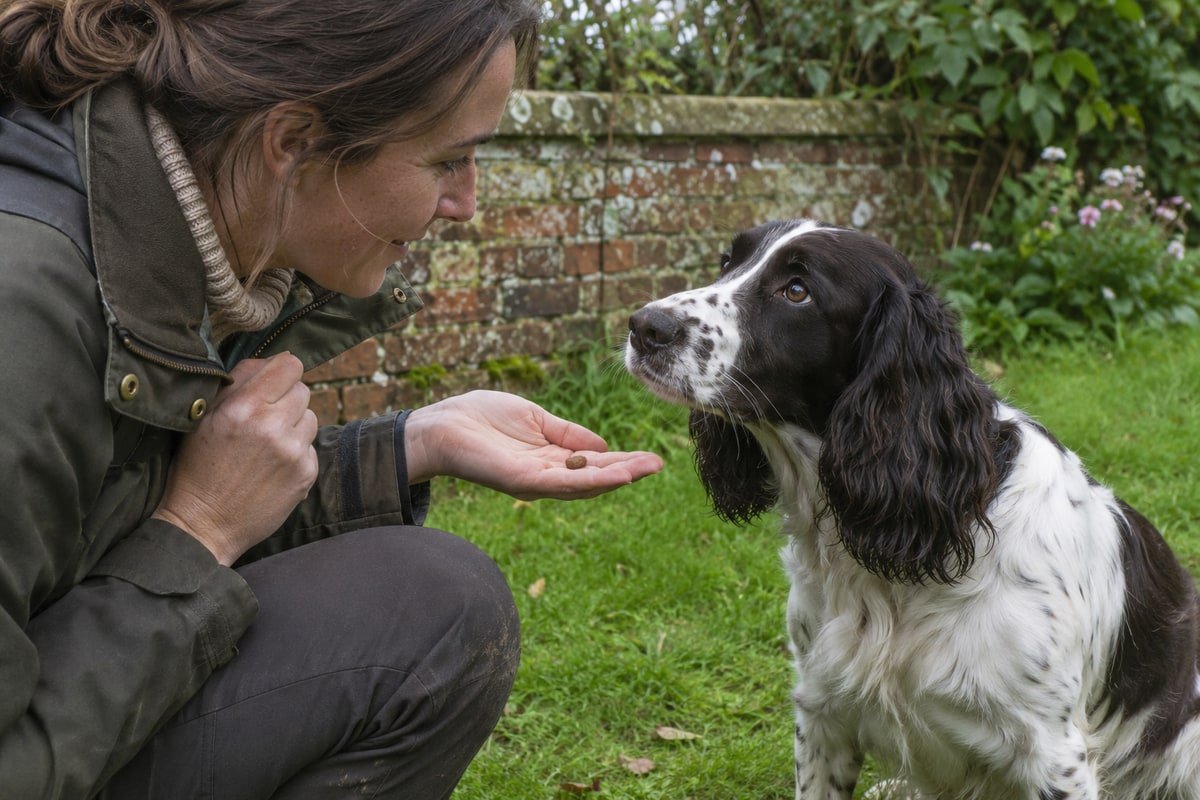
For the full progression, see Dogs Trust’s whistle recall lesson. When an actual visitor arrives, a gate and a familiar mat can give everyone space while your dog is still learning.
Which dogs should skip the whistle?
Skip it if your dog is scared, anxious or possibly in pain. Skip it too if the barking started suddenly or only happens when you leave.
- Fearful or sound-sensitive dogs. Skip it if your dog flinches, hides or avoids the sound.
- Separation anxiety. The ASPCA says this barking occurs only when a dog’s caretaker is gone or the dog is left alone.
- Sudden barking. New barking can mean pain or illness, so call your vet first.
- Several dogs at home. The AKC notes that all the dogs receive the correction, even if only one is barking.
- Aggression. Barking with growling, lunging or snapping needs a qualified behavior professional, not a gadget.
If your dog panics, stops eating, hurts themselves or destroys things when left alone, talk to your vet or a certified trainer. Anxiety can look like pain or an illness.
If your dog is a puppy, a plan beats a gadget. The Puppy Protocol is a four-week puppy barking plan with fillable worksheets.
Not sure a device fits your dog?
Answer a few questions before you shop. It needs no sign-up.
What does AVSAB say about training tools?
The American Veterinary Society of Animal Behavior (AVSAB) recommends only reward-based training for all dog training. It says aversive methods should not be used.
The AVSAB board statement lists electronic collars, prong collars, choke chains and other forms of punishment as aversive. A whistle is not named.
In our view, a sound that predicts a treat is a cue you taught. A sound blown to startle a dog into silence sits closer to the aversive side.
AVSAB does not endorse this store or any device.
Is a handheld ultrasonic device different from a whistle?
A handheld ultrasonic device also gives a sound, but you press a button instead of blowing. It has the same limits as a whistle: it may interrupt a bark, and it does not explain the bark.
For push-button interrupters, see what the evidence says about anti-bark devices.
Our handheld bark deterrent is button-operated and charges by USB-C. It is listed for dogs 6 months to 8 years old, with a stated range of 350 feet. That range is the maker’s figure, not our test. You need to be present to use it.
Skip it if your dog fears the sound. Stop if your dog freezes, hides or tries to get away.
Read our review of the button-operated handheld for the controls and their limits before you decide.
Want to see the handheld deterrent?
See the controls, who it is for and who should skip it.
Quick answers
Can I use a dog whistle on my neighbor’s barking dog?
It will not fix why that dog barks, and you cannot know how the dog will react. Talk with your neighbor first, then check your local noise rules.
Will a whistle stop my puppy from barking?
Puppies bark for needs like sleep, play and toileting, which a whistle cannot meet. Start with our guide to finding your dog’s barking trigger.
Do dog whistles hurt dogs’ ears?
We found no trusted source that settles this, so we will not promise either way. Stop if your dog flinches, yelps or hides, and ask your vet.
Can a whistle help with separation anxiety?
No. Barking only when you are gone needs a different plan, so see your vet or a certified trainer.
Sources
- ASPCA: Barking. Causes of barking, quick-fix expectations and the Quiet cue.
- AVSAB: Position statements and handouts for the public. The humane dog training position.
- Dogs Trust’s whistle recall lesson. How to pair the sound with returning to the handler.
- AKC: Bark Control Tools to Help Stop Nuisance Barking. How ultrasonic tools work and who should get trainer advice.
About the author
Michael Northcutt, PhD
Founder, PawsPurrfection.com · Certified Pet Therapy Specialist · Certified Companion Animal Rehabilitation Therapist (CCAT) · Member, AAPT Certification Board
Dr. Michael Northcutt is a pet therapy and companion-animal rehabilitation professional with 14 years of experience. His work covers animal-assisted interventions, rehabilitation, animal welfare and the human-animal bond.
He holds the CCAT credential from North Carolina State University College of Veterinary Medicine. He also serves on the Animal Assisted Play Therapy® (AAPT) Certification Board. He was a keynote speaker at the 2017 International Veterinary Symposium Conference.
His core principle: what we do for an animal should support its health, comfort, safety and quality of life. Not a veterinarian.