Beagle barking / Updated
Why is my Beagle baying? What to do at the window, on a scent, and when you leave
If your Beagle bays at the mail carrier, cover the part of the window your dog watches before the next delivery.
If the same long call starts when you pick up your keys, record what happens after you leave. Those two sounds can need different answers.
 By Michael Northcutt, PhD · Last updated November 27, 2026January 2027 series ·
What does that long Beagle bay mean?
Listen to what came just before it. Nose down, zigzagging along a hedge? Your hound may be following a scent. Chin up, eyes fixed on the sidewalk? Check what’s passing the house. VCA describes the breed as “highly driven by scent” and notes that Beagles may get vocal on a trail or when bored. VCA’s Beagle breed profile
The call itself won’t tell you whether your dog is having a good time. Watch what comes next. A Beagle who sniffs another patch of grass and trots along with you gives you different information from one who stays planted at the door after the hallway empties.
| When the bay starts | What to watch next |
|---|---|
| Mail carrier passes | Can your dog leave the window? |
| Nose follows a trail | Does your dog check in when their nose lifts? |
| Front door closes behind you | Does your dog settle or keep pacing? |
How do I stop the mail run from becoming a daily concert?
Look at the window from your Beagle’s height. You can close the curtains and still leave a gap beside the sofa where a small hound has a perfect view. Cover that strip or move the dog’s usual perch. Leave the rest of the window clear if you enjoy the light. PetMD’s guide to barking
Before the mail usually comes, invite your dog to join you somewhere they can’t watch the path. Keep a few pieces of their regular food handy. If they hear the gate and glance toward you, reward that glance. If you first notice the carrier because the baying has already started, close the view and give your dog room to settle. Try an earlier start tomorrow.
A useful test: Did your dog go back to what they were doing after the carrier passed? That’s a win you can hear. Counting every bark is optional.
What helps when my Beagle’s nose takes over on walks?
Build a sniffing stop into a walk you already take. Choose a safe patch well away from the road and keep the leash attached. Give your dog time to investigate; when their nose lifts on its own, say their name once and reward them for checking in. Try that first where there’s little going on. VCA’s Beagle breed profile
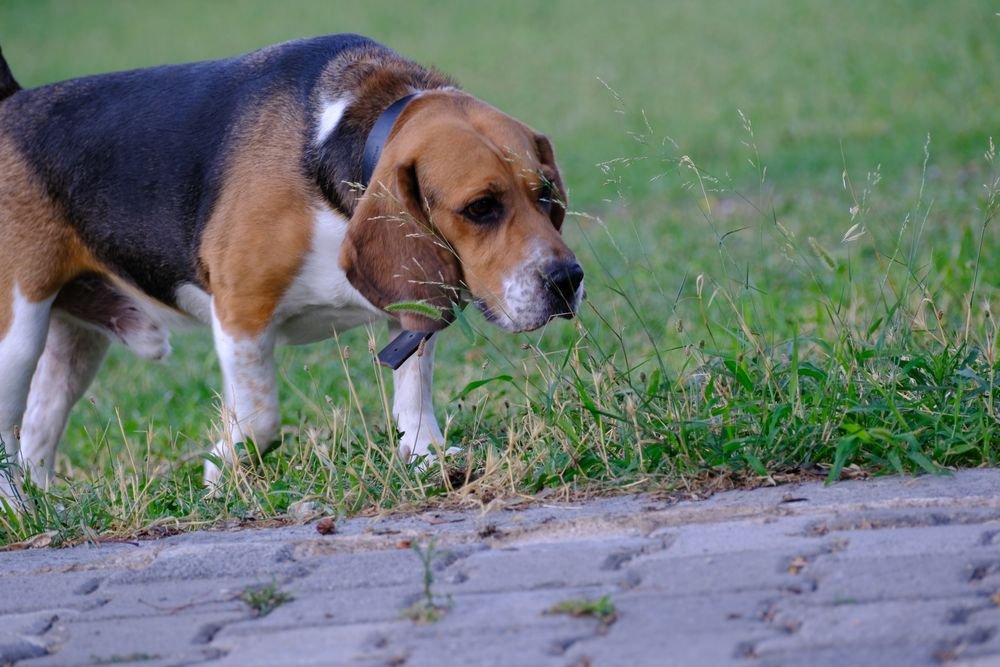
Save the cue for a moment when your dog can hear you. Five increasingly loud calls while their nose follows a fresh trail give you less practice than one easy turn back. At home, you can scatter part of a meal on a clear floor for a supervised sniff-and-find game. Pick it up when you finish, particularly in a home with several pets.
What if the howling starts as soon as I leave?
During an ordinary departure, record the area around the door. Look for what happens between calls. Does your Beagle return to bed when the trash truck moves on? Or are they pacing the same route, drooling, pawing at the exit and getting more upset? Keep that clip for your vet. ASPCA guidance on separation anxiety
A longer walk may be enjoyable, but it doesn’t establish why your dog howls in an empty house. If there are signs of distress, avoid deliberately leaving your dog to howl it out. Ask your vet about support and, when possible, use a familiar sitter for absences your dog already struggles with. ASPCA guidance on separation anxiety
What can our household practice this week?
- Pick one situation. Choose the front window or the sound of keys. Work on whichever one disrupts your day most.
- Choose a response you can see. At the window, that might be turning away from the glass and walking to you. Practice in a quiet room first.
- Reward the first easy attempt. A look over the shoulder counts. You can ask for a longer pause once the first step is familiar.
- Compare like with like. Write down how one ordinary delivery went. A whole afternoon of construction noise makes a poor comparison with yesterday’s mail run.
Log one mail run or sniff walk in the 7-Day Bark Trigger Tracker. When it happens again, compare what set off the bay and how long it took your Beagle to settle.
For a puppy, keep the first practice small enough to finish while they still want to play. For an adult whose calls have suddenly changed or who seems uncomfortable, share that change with your vet before adding more training. PetMD’s guide to barking
For short alert barks as well as baying, use the guide to matching a response to the trigger.
Quick answers
Do I have to stop my Beagle from baying on every walk?
Decide which situations need help. An occasional call on a sniff walk may be fine for your household. Recovering after a delivery or being comfortable home alone may matter much more.
Should I shout over the howl?
Move away from the trigger and reward a pause when your dog can hear you again. A louder human voice gives an excited hound another sound to respond to. The AKC on teaching a place cue.
Where can I read more?
Practicing with a puppy?
The Puppy Protocol includes a barking guide, worksheets and a four-week household roadmap.
Considering a handheld tool for barking? Click Here to Read the Ultrasonic Deterrent Guide.
Sources
- VCA’s Beagle breed profile
- PetMD’s guide to barking
- ASPCA guidance on separation anxiety
- The AKC on teaching a place cue
About the author
Michael Northcutt, PhD
Founder, PawsPurrfection.com · Certified Pet Therapy Specialist · Certified Companion Animal Rehabilitation Therapist (CCAT) · Member, AAPT Certification Board
Dr. Michael Northcutt is a pet therapy and companion-animal rehabilitation professional with 14 years of experience. His work covers animal-assisted interventions, rehabilitation, animal welfare and the human-animal bond.
He holds the CCAT credential from North Carolina State University College of Veterinary Medicine. He also serves on the Animal Assisted Play Therapy® (AAPT) Certification Board. He was a keynote speaker at the 2017 International Veterinary Symposium Conference.
His core principle: what we do for an animal should support its health, comfort, safety and quality of life. Not a veterinarian.
Disclaimer: This page is general education, not veterinary advice. Call your vet about any sudden or worrying change in your dog.