Dog barking / Updated
Your dog is barking at nothing? What they can sense that you can’t, and what to do tonight
Your dog may be reacting to a sound, movement or scent you missed.
Watch where they look, then call them away and reward them for turning toward you.
 By Michael Northcutt, PhD · Last updated November 27, 2026January 2027 series ·
We read the AKC, ASPCA and PetMD pages in full. General education only, not veterinary advice.
Quick answer: Your dog may be reacting to a faint sound, a dim shape or a scent. Watch where they look and what happens before the bark. Stay calm, say a soft thank you, and watch for one minute. If it is new or comes with confusion, call your vet.
Key takeaways
- Dogs hear softer, higher sounds and see far better in low light than you do.
- A calm “thank you” works better than yelling. Barking is contagious, per the AKC.
- Teach a Quiet cue when things are calm, using tiny treats and longer waits.
- New night barking, pacing or confusion in an older dog needs a vet visit.
- Skip sound devices if your dog seems scared or anxious.
It is 2 a.m. Your dog is standing in the dark hallway, barking at an empty corner.
You look. You listen. Nothing. Then the doubts start. Is something wrong with my dog? Is someone outside?
If you have typed this into Google half awake, you are not alone. This kind of barking can wear down your sleep, your patience and even your relationship with the neighbors.
Here is what matters most. In the next minute, you either calm the room or add fuel. The ASPCA says scolding or eye contact can feel like a reward to a dog who barks for attention.
So let us sort this out together, starting with what your dog may be sensing.
Why is my dog barking at nothing?
Your dog is usually reacting to a sound, sight or smell you cannot sense. Sometimes the cause is attention, other dogs barking, or a health change that needs your vet.
For a puppy who does this in several places, use the puppy barking guide to record one example at a time.
Use this table to match what you see to a likely cause. These are common patterns, not a diagnosis.
| What you notice | What it may mean | Your first step |
|---|---|---|
| Ears and head turn toward a wall or window | A soft or high sound you cannot hear | Listen for one minute. Note the time. |
| Barks at dusk or in dark rooms | Shapes and movement seen in low light | Close the blinds. Turn on a soft light. |
| Sniffs the door gap, then barks | A scent from wildlife or a passing animal | Stay calm. Check the yard with a light. |
| Stiff body, steps forward with each bark | Alarm barking, as the ASPCA describes it | Block the view. Teach Quiet. |
| Barks only when other dogs bark | Socially facilitated barking | Play music. Reward quiet. |
| Looks at you, barks, then waits | A bid for attention or play | Turn away. Reward the quiet. |
| Same spot, same rhythm, spinning or pacing | Possible compulsive barking | Call your vet, then a behavior professional. |
| Older dog wanders at night, stares at walls, sleeps more by day | Possible cognitive change, which needs a vet | Book a vet visit. Write down the changes. |
Can dogs sense things I cannot?
Yes. Dogs hear higher and softer sounds, see far better in low light, and smell a world of scent we cannot. So “nothing” often has a trigger.
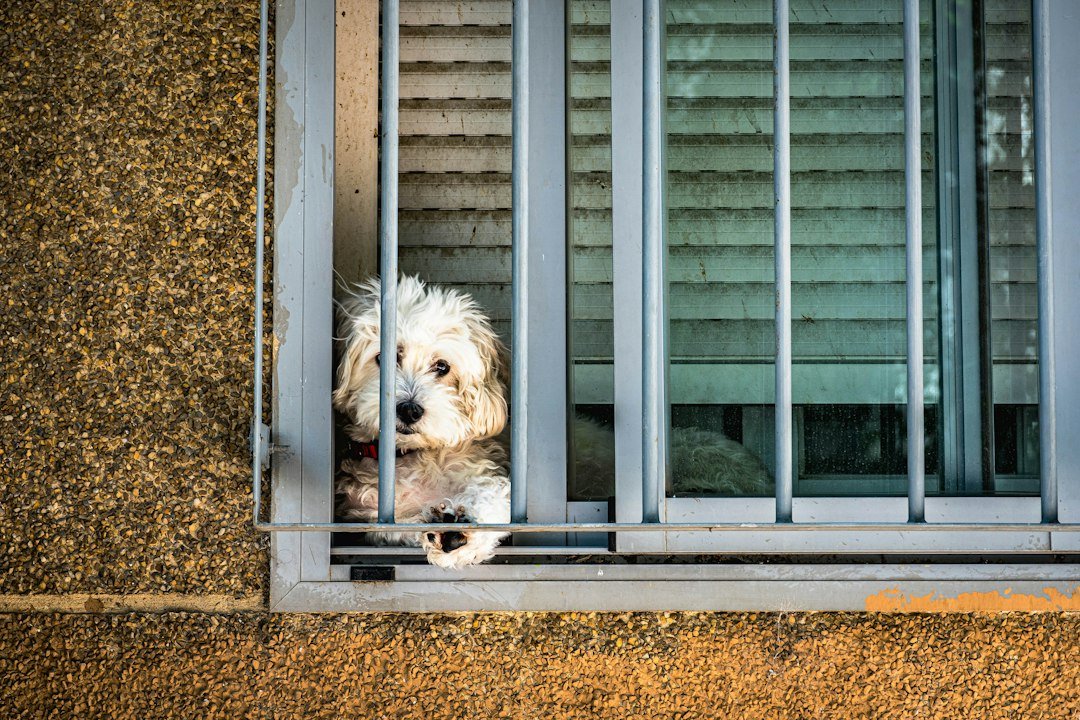
Your dog is not being dramatic. Their senses are simply tuned to different things. The AKC explains that dogs can hear higher-pitched sounds than humans. They also catch sounds far too quiet for your ears.
Then there is scent. Dogs have far more scent-sensing neurons than people, and a bigger part of the brain for smell. A faint trace of prey or danger can set off a bark.
Why does your dog bark at nothing mostly at night?
Dogs see with a fraction of the light you need, so a dark yard is full of shapes to them. In older dogs, night barking can also signal a health change.
Dogs have a reflective layer behind the retina called the tapetum lucidum. The AKC says it lets dogs see with only one quarter of the light humans need. A yard that looks black to you is full of movement to them.
Older dogs are a different story. PetMD, which is vet-reviewed, lists sleeping more by day and staying awake at night as a sign of dog dementia. It also describes dogs found barking at seeming nothing in a room.
One owner on Reddit said their 13-year-old German shepherd barked at empty walls. Their vet diagnosed canine cognitive dysfunction. That is one story, not proof, but it shows why age matters.
Tonight, write down the time, the room and your dog’s age. That note makes a vet visit faster.
What should you do in the next 60 seconds?
Stay calm and say a quiet “thank you.” Do not yell. Your dog may think you are barking too, which can make things louder.
- Say a calm “thank you” or “I know.” The AKC says this shows your dog the warning was heard.
- Do not yell. The AKC notes that barking is contagious, so shouting can add fuel.
- Look and listen for one minute at the spot your dog faces.
- Write down the time, the place and what happened just before.
- Call your dog away from the window, ask for a sit, and reward the quiet.
Dreading the next 2 a.m. wake-up?
The Puppy Protocol is a four-week barking plan for puppies, with fillable worksheets.
How do you teach a Quiet cue?
Teach Quiet while things are calm. Say “Quiet,” feed tiny treats, then wait longer before each treat: 2, 5, 10, then 20 seconds.
The ASPCA describes this method. When your dog barks, calmly say “Quiet” and feed a steady stream of pea-sized treats. Do not shout the cue.
Over time, your dog may begin to pause when they hear the cue. Then you slowly lengthen the wait before the treat.
- Use treats your dog loves, like chicken or cheese.
- Practice with a safe trigger, such as a doorbell, as the AKC suggests.
- Block the view with removable window film, which the ASPCA lists for dogs who guard from inside.
- If Quiet fails after 10 to 20 tries, the ASPCA says to find a certified behavior professional.
When is barking at nothing a clue your vet needs to hear?
Ask your vet to rule out pain or illness first, as the ASPCA advises. Older dogs who pace or wander at night need a vet visit.
PetMD says senior dogs face the highest risk of dementia. Signs include disorientation, pacing at night and barking for no apparent reason. If you notice any of them, tell your vet.
The ASPCA also describes compulsive barking. Some dogs bark in a rigid, repeated way at shadows, light flashes, mirrors or open doors. Many also spin, circle or pace.
Barking only when you are gone, with pacing or destruction, points to separation anxiety instead. The ASPCA treats that as its own problem.
If your dog panics, stops eating, hurts themselves or destroys things when left alone, talk to your vet or a certified trainer.
Please avoid punishment when fear or anxiety drives the barking. The ASPCA warns it can make your dog feel worse, so the barking may increase.
Should you reach for an anti bark device?
Not as a first step. A device cannot tell you why your dog is barking. Skip any sound device if your dog seems scared or anxious.
The ASPCA calls anti-bark collars punishment devices and not a first choice. It says this is especially true for barking from fear, anxiety or compulsion.
If you still want to weigh one, read our ultrasonic dog bark deterrent review first.
Not sure what fits your dog?
Answer a few questions before you shop. It needs no sign-up.
Quick answers
Is my dog seeing ghosts?
The AKC says there is a logical reason for the barking. It points to sounds, sights and smells you cannot sense.
Is it normal for an older dog to bark at nothing?
PetMD lists barking at seeming nothing and night pacing as possible signs of dog dementia. Tell your vet about any new pattern.
Should I ignore my dog when it barks at nothing?
Only if the barking is for attention, as the ASPCA explains. If your dog may be warning you, acknowledge it calmly first.
Why does my puppy bark at nothing?
Puppies have the same senses, so the same causes apply. Start the Quiet cue early.
Sources
- AKC: Why Does My Dog Bark at Nothing?. Dog hearing, low-light vision, scent and the Quiet cue.
- ASPCA: Barking. Types of barking, vet check, compulsive barking and Quiet training.
- PetMD: What Is Dog Dementia?. Vet-reviewed signs of canine dementia, including night pacing and barking at nothing.
About the author
Michael Northcutt, PhD
Founder, PawsPurrfection.com · Certified Pet Therapy Specialist · Certified Companion Animal Rehabilitation Therapist (CCAT) · Member, AAPT Certification Board
Dr. Michael Northcutt is a pet therapy and companion-animal rehabilitation professional with 14 years of experience. His work covers animal-assisted interventions, rehabilitation, animal welfare and the human-animal bond.
He holds the CCAT credential from North Carolina State University College of Veterinary Medicine. He also serves on the Animal Assisted Play Therapy® (AAPT) Certification Board. He was a keynote speaker at the 2017 International Veterinary Symposium Conference.
His core principle: what we do for an animal should support its health, comfort, safety and quality of life. Not a veterinarian.
Disclaimer: This page is general education, not veterinary advice. Call your vet about any sudden or worrying change in your dog.